A Dental Hygiene Routine for Every Age
An oral hygiene routine from birth to age 8: gums, first tooth, toothbrush, fluoride toothpaste by age and country, flossing, and how long an adult should help.
A child's oral hygiene isn't a fixed task; it's a routine that changes as they grow. What a newborn with no teeth needs has little in common with what a 5-year-old with a mouthful of molars needs. What doesn't change is the goal: remove plaque every day, make the most of fluoride's protective effect, and build a habit that lasts a lifetime.
Pediatric dental and medical organizations agree on a few basics: clean from the first tooth, twice a day, with fluoride toothpaste in the right amount for the child's age; add floss once teeth touch; and have an adult do the brushing in the early years. This article organizes all of that by stage, so you know what to do and when.
For a quick visual version, see our oral hygiene guide by age.
Birth to 6 months: the gums
Before the first tooth, there are no teeth to decay and no need for toothpaste. Even so, many families gently wipe the gums once a day, during bath time or after the last feed, and the ADA and AAP suggest wiping after feeds.
How: wash your hands, wrap your index finger in clean gauze dampened with water or use a soft cloth, and wipe gently along the top and bottom gums.
What's the point without teeth? Mainly, your baby gets used to having their mouth touched, so the toothbrush won't feel strange when it arrives. We explain more in how to clean your baby's gums.
First tooth to age 3
With the first tooth, usually around 6 months, proper cleaning begins: twice a day, in the morning and, above all, at night.
- Tool: gauze, a silicone finger brush or a baby toothbrush. By around the first birthday, when there are several teeth and molars are coming in, a child's toothbrush with a small head and soft bristles is the most effective choice.
- Toothpaste: fluoride toothpaste in a smear or grain-of-rice amount. The NHS specifies at least 1,000 ppm fluoride; EAPD guidance recommends 1,000 ppm and suggests moving to a pea-sized amount from age 2. The AAPD and ADA recommend a grain-of-rice amount until age 3.
- Who: always the adult.
- Afterwards: no need to rinse; if your baby can't spit, wipe away the extra with gauze.
Helpful positions at this age: your baby lying in your lap with their head on your thighs, or sitting on your lap facing away from you with their head resting against your chest. Both leave one hand free to lift the lip and the other to brush.
The bedtime brush matters most, because less saliva is produced during sleep and the mouth is less able to protect itself. If you can only manage one brush on a hectic day, make it the one before bed.
Flossing once molars touch
Between ages 1 and 3, the baby molars come in. Once two teeth are touching, the brush can't reach that space properly. The American Dental Association (ADA) recommends starting to floss as soon as two teeth touch, with an adult doing it. Floss holders with handles can make it easier in small mouths. Bedtime is a good moment.
Ages 3 to 6
At this age children want to do it themselves, and practice is good, but they still don't have the dexterity to clean every surface well.
- Toothpaste: a pea-sized amount of fluoride toothpaste. The NHS recommends 1,000–1,500 ppm; EAPD guidance recommends 1,000 ppm. A dentist may adjust this if your child has a higher risk of decay.
- Time: about two minutes. The toothbrushing timer helps.
- Technique: your child brushes first, then you go over it. Letting them "have a go" before an adult does the real clean works well. Our step-by-step guide on how to brush a child's teeth covers technique in detail.
- Afterwards: spit out the toothpaste without rinsing.
- Floss: still done by an adult, ideally at night.
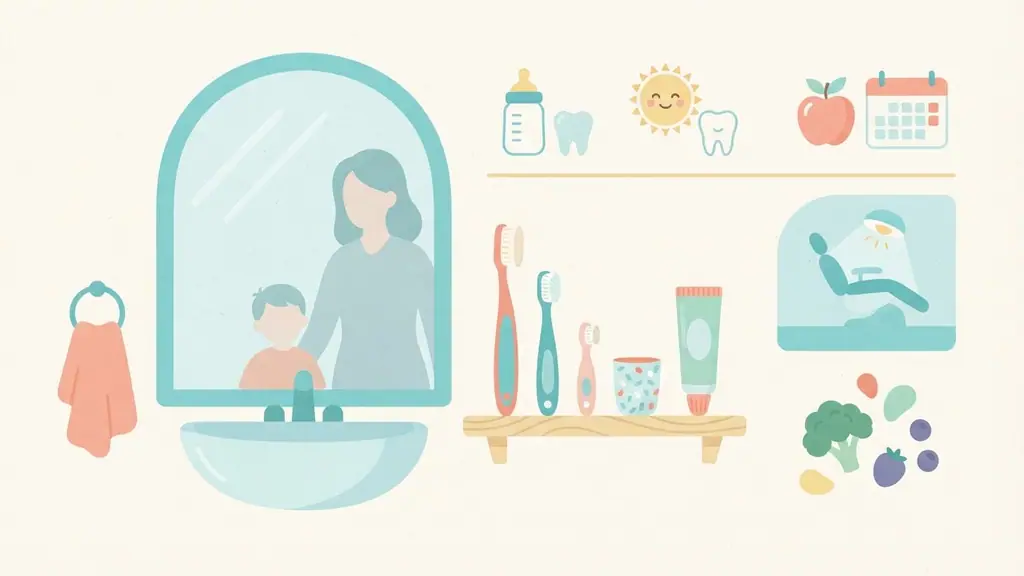
Helpful position: stand behind your child in front of the mirror, with their head resting against you. You can see inside the mouth, and they can watch what you're doing.
From age 6
At around 6, the baby front teeth start to fall out and the first permanent molar comes in behind the baby molars, without any tooth falling out first. It's meant to last a lifetime, so brush it with extra care.
- Toothpaste: a pea-sized amount. EAPD guidance recommends 1,450 ppm from age 6; the NHS recommends 1,350–1,500 ppm from age 7. A dentist may recommend a higher-strength toothpaste for children at high risk of decay.
- Who: your child becomes more independent, but an adult still supervises and checks, especially at night.
How long should an adult help?
Organizations phrase it differently. The NHS says children aged 7 and over should be able to brush their own teeth. The EAPD advises helping or supervising until at least age 7. The American Academy of Pediatrics (AAP) suggests assisting or supervising until children have mastered it, usually at around age 10, and the ADA notes that children typically take over flossing around 10 or 11. In practice, most children need at least an adult check until they're 7 or 8.
Summary by age
| Stage | Tool | Fluoride toothpaste | Who | Extra |
|---|---|---|---|---|
| 0–6 months (no teeth) | Damp gauze or cloth | None | Adult | Builds the habit |
| First tooth to 3 years | Gauze, finger brush or baby toothbrush; child's toothbrush by about age 1 | Smear or grain of rice (at least 1,000 ppm in UK/EU guidance) | Adult | Floss once molars touch |
| 3–6 years | Child's toothbrush | Pea-sized (1,000 ppm in EAPD guidance; up to 1,500 in the UK) | Child practices, adult finishes | Spit, don't rinse |
| 6 years and up | Age-appropriate toothbrush | Pea-sized (1,450 ppm in EAPD guidance from 6; 1,350–1,500 in the UK from 7) | Child, with supervision | Care for the 6-year molars |
Beyond the toothbrush: visits and habits
Home care works best alongside professional check-ups. A first dental visit is recommended by the first birthday or within six months of the first tooth (AAPD, ADA, AAP); the NHS suggests going when the first teeth appear. After that, the dentist will tell you how often to return. At these visits they can assess decay risk, apply fluoride varnish if appropriate and answer questions about technique. Our first dental visit checklist helps you prepare.
Diet matters too: keep free sugars low and avoid constant grazing, don't put your child to bed with a bottle of milk or juice, and never sweeten a pacifier (dummy).
When to see a professional
Book a dental appointment if you notice chalky white or brown patches on the teeth, gums that bleed often, persistent bad breath or pain when chewing, or if you're unsure which toothpaste to use.
The essentials
- Gums: gentle wiping from birth helps build the habit.
- First tooth: brushing twice a day with a tiny amount of fluoride toothpaste.
- Ages 3 to 6: a pea-sized amount, two minutes, and an adult check.
- Floss as soon as two teeth touch.
- An adult brushes or supervises until at least age 7 or 8.
Sources and further reading
- Taking care of children's teeth, NHS
- Policy on the Use of Fluoride, American Academy of Pediatric Dentistry
- Flossing, American Dental Association (MouthHealthy)
- Brushing Up on Oral Health: Never Too Early to Start, American Academy of Pediatrics (HealthyChildren.org)
- Guidelines on the use of fluoride for caries prevention in children: an updated EAPD policy document, European Academy of Paediatric Dentistry (Eur Arch Paediatr Dent)