How to Clean Your Baby's Gums
Why and how to clean a baby's gums before the first tooth: what to use, a simple step-by-step routine, how often, and when white patches need checking.
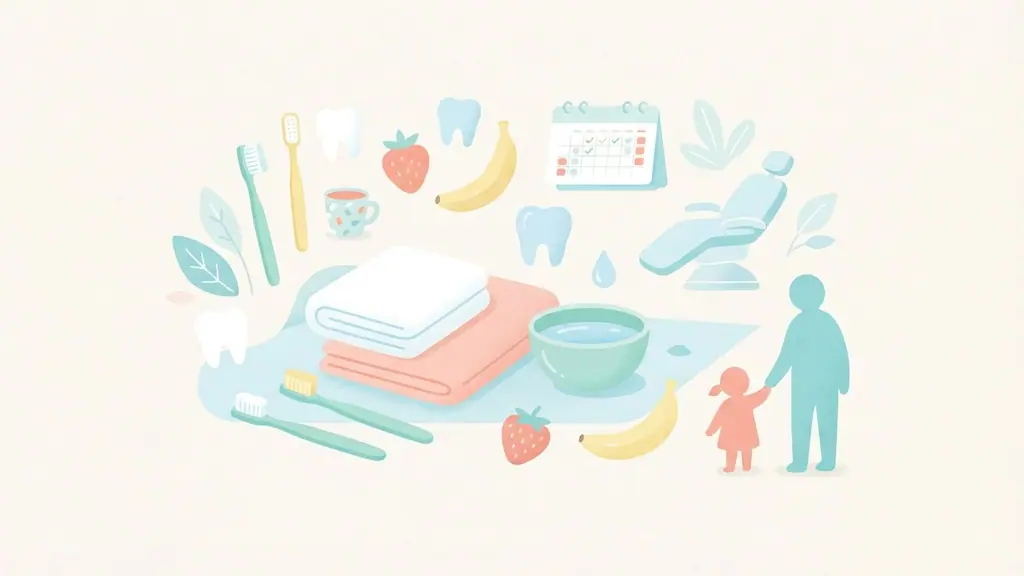
You don't need any special products to clean a baby's gums. A clean, damp washcloth or a piece of gauze wrapped around your finger is enough. Wipe gently over the top and bottom gums, once or twice a day, and you're done in under a minute.
The American Academy of Pediatrics (AAP) and the American Dental Association (ADA) both suggest wiping your baby's gums after feeds, even before any teeth appear. The CDC suggests doing it twice a day.
It's a small habit with a few genuine benefits, and it makes the move to toothbrushing much easier later on. Here's how to do it, step by step.
Why clean gums when there are no teeth?
- It removes milk residue. Breast milk and formula both contain natural sugars. Wiping clears away what's left after a feed.
- It gets your baby used to having their mouth touched. Babies who are familiar with a gentle mouth routine often accept a toothbrush more easily when the first tooth appears.
- It lets you see what's happening. Regular cleaning means you'll notice a tooth on its way, a white patch or a sore spot early.
- It starts a family routine. A habit built in the first months is easier to keep than one introduced to a determined toddler.
What you need
| Option | Good to know |
|---|---|
| Clean, soft washcloth or muslin | Easy and cheap; use a fresh one each time or wash after use |
| Sterile gauze pad | Thin and easy to wrap around a finger |
| Silicone finger brush | Optional; some parents find it easier to grip |
| Plain water | No toothpaste is needed until the first tooth |
Wash your hands before you start, and keep your nails short. You won't need toothpaste at this stage; fluoride toothpaste starts with the first tooth.
Step by step
- Pick a calm moment. After a feed, after the bath or as part of the bedtime routine all work well.
- Get comfortable. Hold your baby in your lap with their head supported in the crook of your arm, or lay them on a changing mat facing you.
- Wrap and dampen. Wrap the cloth or gauze around your index finger and moisten it with clean water. Squeeze out any excess.
- Wipe the gums gently. Slide your finger along the top gum, front and back, then the bottom gum. Use light pressure, as if wiping a cheek.
- Include the cheeks and tongue. If your baby is relaxed, gently wipe the inside of the cheeks and the top of the tongue.
- Keep it short and warm. Talk or sing to your baby. A few seconds is fine at first; it will get easier.
- Clean up. Wash the cloth or throw away the gauze.
If your baby is upset, stop and try again later. The aim is a calm, familiar routine, not a perfect clean every time.
How often?
Once or twice a day is a good target. Wiping after every feed, as the AAP suggests, isn't realistic for every family. If you can only manage one wipe a day, make it after the last feed before night-time sleep.
Tiny white dots on the gums or palate
Many newborns have small, pearly white bumps along the middle of the roof of the mouth (Epstein pearls) or on the gum ridges (Bohn's nodules or gingival cysts). At first glance they can look like a tooth coming through, but they're soft to the touch. They're harmless leftovers from development that usually disappear on their own within the first weeks or months and don't need treatment. Don't try to pop or scrape them; just keep cleaning gently and mention them at the next check if they don't go away.
A milky tongue, or something else?
A thin white coating on the tongue after feeds is common and usually wipes off easily. White patches that don't wipe away, or that leave a sore or red area underneath, could be oral thrush, a common yeast infection in babies. If you notice this, or if your baby seems uncomfortable when feeding, check with your pediatrician, family doctor or health visitor. If you're breastfeeding and your nipples become sore or cracked at the same time, mention that too.
When the first tooth appears
As soon as the first tooth breaks through, switch from a cloth to a soft baby toothbrush and start using fluoride toothpaste twice a day:
- US (AAPD, ADA, AAP): a smear the size of a grain of rice until age 3.
- UK (NHS): a smear of toothpaste containing at least 1,000 ppm fluoride.
- Europe (EAPD): 1,000 ppm toothpaste in a grain-of-rice amount up to age 2.
Our guide on when to start brushing your child's teeth covers the switch in detail, and the oral hygiene guide by age shows what changes at each stage.
It's also time to book a first dental visit: the AAPD, ADA and AAP recommend one within six months of the first tooth and by the first birthday at the latest. To find out when teeth usually arrive, see when do babies get their first teeth?
Habits that support healthy gums
- Don't dip a pacifier (dummy) in honey, sugar or anything sweet.
- Avoid "cleaning" your baby's pacifier or spoon in your own mouth, which can pass on decay-causing bacteria.
- Try not to let your baby fall asleep feeding from a bottle of milk or formula as a regular habit, especially once teeth arrive.
- Keep your own teeth and gums healthy, since your mouth is the one closest to theirs.
When to see a professional
Contact your pediatrician, family doctor, health visitor or a pediatric dentist if you notice:
- White patches that don't wipe off, or a baby who seems to find feeding painful
- A tooth present at birth or in the first weeks, especially if it's loose
- Swelling, a lump, or a bluish bump on the gum that seems painful or keeps growing
- Bleeding from the gums without an obvious cause
- A sore or ulcer that doesn't heal or keeps coming back
Seek urgent care if your baby has a fever and seems unwell, is refusing feeds, or has fewer wet diapers than usual.
In short
- Wipe your baby's gums with a clean, damp cloth or gauze once or twice a day.
- No toothpaste until the first tooth.
- Keep it gentle, brief and part of a calm routine.
- Switch to a soft toothbrush and fluoride toothpaste when the first tooth appears, and book that first dental visit. For the bigger plan, see preventive oral care from birth.
Sources and further reading
- How to Prevent Tooth Decay in Your Baby, American Academy of Pediatrics (HealthyChildren.org)
- Baby Teeth, American Dental Association (MouthHealthy)
- Oral Health Tips for Children, Centers for Disease Control and Prevention
- Taking care of children's teeth, NHS