Fluoride Toothpaste: How Much to Use at Each Age
How much fluoride toothpaste to use from the first tooth to age 6 and beyond: smear vs pea-sized amounts, ppm strength, and how US and UK/EU advice differs.
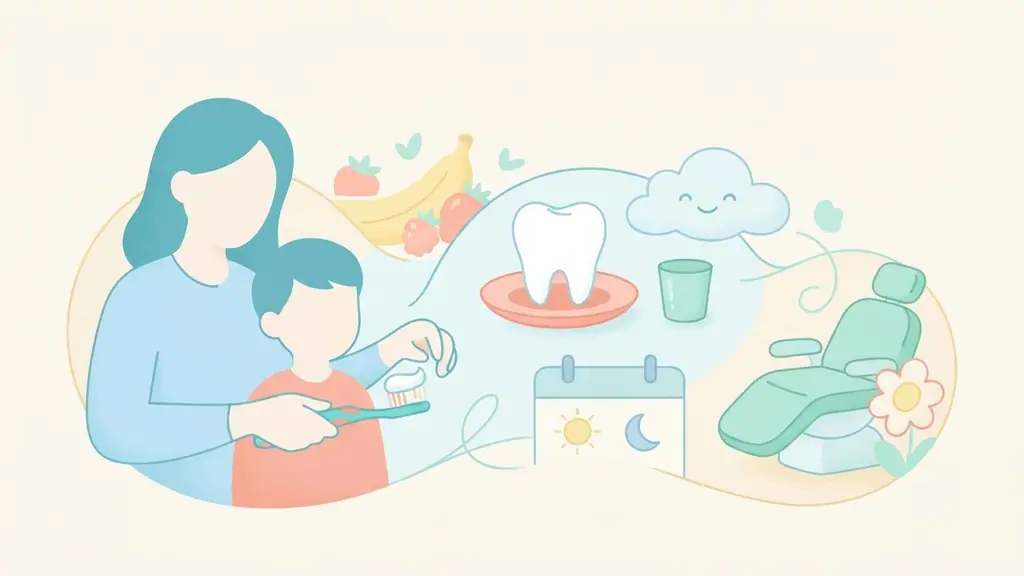
Fluoride toothpaste is one of the simplest, best-supported ways to protect young teeth from decay, and it is recommended from the moment the first tooth appears. The trick is the amount: very young children swallow much of what goes on the brush, so the dose is kept tiny and grows as your child learns to spit.
In short: a smear (about the size of a grain of rice) until age 3, then a pea-sized amount from 3 to 6. Brush twice a day, with one of those times last thing before bed. Where guidelines differ, it is mostly about the strength of the toothpaste (measured in ppm, parts per million of fluoride) and the exact age cut-offs, which vary by country.
Why the amount matters
Fluoride works on the tooth surface. It helps repair the earliest mineral loss caused by acids and makes enamel more resistant to future attacks. That protective effect comes from regular, gentle contact, not from large quantities.
The reason for small amounts is dental fluorosis: if young children regularly swallow more fluoride than they need while their permanent teeth are still forming under the gums, those teeth can later show faint white flecks or lines. In the amounts recommended here, fluorosis is usually very mild and cosmetic, and the benefit in preventing decay clearly outweighs that risk, according to the American Dental Association (ADA), the American Academy of Pediatric Dentistry (AAPD) and the European Academy of Paediatric Dentistry (EAPD).
How much toothpaste at each age
The table below sets the main recommendations side by side. Read across a row to see how US and UK/European advice compare for the same age.
| Age | US guidance (AAPD, ADA, AAP) | UK guidance (NHS) | European guidance (EAPD 2019) |
|---|---|---|---|
| First tooth to 2 years | Smear (grain of rice), fluoride toothpaste | Smear, at least 1,000 ppm | Grain of rice (about 0.125 g), 1,000 ppm |
| 2 to 3 years | Smear (grain of rice) | Smear, at least 1,000 ppm | Pea-sized (about 0.25 g), 1,000 ppm* |
| 3 to 6 years | Pea-sized amount | Pea-sized, 1,000–1,500 ppm | Pea-sized, 1,000 ppm* |
| 6 years and over | No separate amount given; keep supervising | From 7: 1,350–1,500 ppm | 1,450 ppm, 0.5–1 g (up to the full length of the brush head) |
*The EAPD notes that a higher concentration may be considered for children with a higher risk of decay. The NHS says a dentist may advise a family-strength toothpaste (1,350–1,500 ppm) for younger children, and UK prevention guidance (Delivering Better Oral Health) advocates it for children at higher risk.
US guidance does not set a specific ppm figure for children's toothpaste; it simply calls for a fluoride toothpaste. Most standard family toothpastes contain roughly 1,000–1,500 ppm, and the concentration is printed on the tube or box, sometimes as a percentage of sodium fluoride or sodium monofluorophosphate.
What does a smear look like? Just enough to tint the bristles, about the size of a grain of rice. A pea-sized amount is roughly a small blob across the width of a child's brush head, not a stripe along its length.
Choosing the strength: reading the label
Many toothpastes sold for small children contain less fluoride than family toothpaste, and some contain none. A few practical points:
- Look for the ppm figure. UK and European guidance treats 1,000 ppm as the minimum for a caries-protective effect in young children. The EAPD notes that the evidence for toothpastes below 1,000 ppm is limited.
- "Kids'" packaging does not guarantee fluoride. Check the ingredients for sodium fluoride, stannous fluoride or sodium monofluorophosphate.
- Fluoride-free products do not provide fluoride's protection. If you are considering one for a particular reason, talk it through with your child's dentist first.
- Higher-strength prescription pastes (above 1,500 ppm) exist for specific situations and should only be used when a dental professional prescribes them.
How to brush with fluoride toothpaste, step by step
- Put the right amount on a small, soft brush. Hold the tube yourself; little hands tend to squeeze far too much.
- Brush all surfaces of every tooth (outside, inside and chewing surfaces) for about two minutes. Our toothbrushing timer can make that time feel shorter.
- Encourage spitting, not rinsing. From around age 3, help your child spit out the excess. Rinsing with water washes away the fluoride left on the teeth. For babies and toddlers who cannot spit yet, simply wipe away any obvious excess foam; the smear amount is designed with swallowing in mind.
- Brush last thing at night, after the final drink or snack, and at one other time of day. The bedtime brush matters most, because saliva flow drops during sleep.
- Avoid food and drinks other than water for a while after the bedtime brush.
For a full technique guide with positions for different ages, see how to brush a child's teeth, step by step.
Who should hold the tube?
An adult. Children are enthusiastic squeezers, and toothpaste often tastes pleasant, especially fruit-flavored varieties. Keep tubes out of reach between brushes, and don't let children eat or lick toothpaste from the tube.
Adults should brush for, or closely supervise, children until about 7 to 8 years of age. The EAPD specifically advises assisting or supervising toothbrushing until at least age 7. Before then, most children do not yet have the dexterity to clean every surface well, and they still need help judging the amount.
What if my child swallows the toothpaste?
Swallowing a smear or a pea-sized amount now and then is expected in young children and is not dangerous. The amounts above were chosen precisely because small children swallow some of it. The concern is with eating larger quantities, which is why tubes should be stored safely. If a child eats a large amount of toothpaste, contact your local poison control center or seek medical advice.
Other sources of fluoride to keep in mind
Toothpaste is not the only source of fluoride in a child's life, and the total matters:
- Tap water, if your area adds fluoride or has naturally fluoridated water.
- Fluoride varnish painted on by a dentist or other health professional. The NHS offers it at least twice a year from age 3, and in the US the USPSTF and AAP recommend it for all young children from the first tooth up to age 5.
- Supplements (drops or tablets), which are only prescribed in specific circumstances after a professional has checked your water supply and your child's risk.
That is one reason recommendations differ between countries: background fluoride exposure varies. For the bigger picture on safety and benefits, read fluoride for children: benefits and safety.
When to see a professional
Book a check with a dentist or pediatric dentist:
- By your child's first birthday, or within six months of the first tooth (AAPD, ADA, AAP). The NHS advises taking children when the first milk teeth appear, and before 12 months. Our first dental visit checklist can help you prepare.
- If you notice white chalky patches, brown spots or holes on the teeth.
- If you are unsure which strength suits your child, for example because of a higher decay risk, a medical condition or a fluoride-free water supply.
- If you are worried about white flecks on newly erupted permanent teeth.
Quick reference
- From the first tooth: fluoride toothpaste, twice a day.
- Under 3: a smear (grain of rice). From 3 to 6: a pea-sized amount.
- UK and EAPD guidance: at least 1,000 ppm for young children; 1,350–1,500 ppm from age 6 or 7.
- Spit, don't rinse. Brush last thing at night.
- An adult applies the toothpaste and helps or supervises until about 7–8 years.
For an age-by-age checklist covering gums, brushing and visits, try our oral hygiene by age guide.
Sources and further reading
- Fluoride Therapy (Best Practices), American Academy of Pediatric Dentistry
- Toothpastes (Oral Health Topics), American Dental Association
- Taking care of children's teeth, NHS
- Guidelines on the use of fluoride for caries prevention in children: an updated EAPD policy document, European Archives of Paediatric Dentistry
- Delivering better oral health: Chapter 9, Fluoride, UK Office for Health Improvement and Disparities