Electric Toothbrushes for Children: Pros, Cons and Timing
Are electric toothbrushes better for kids? What the evidence shows, the real pros and cons, when a child can start using one, and how to brush safely with it.
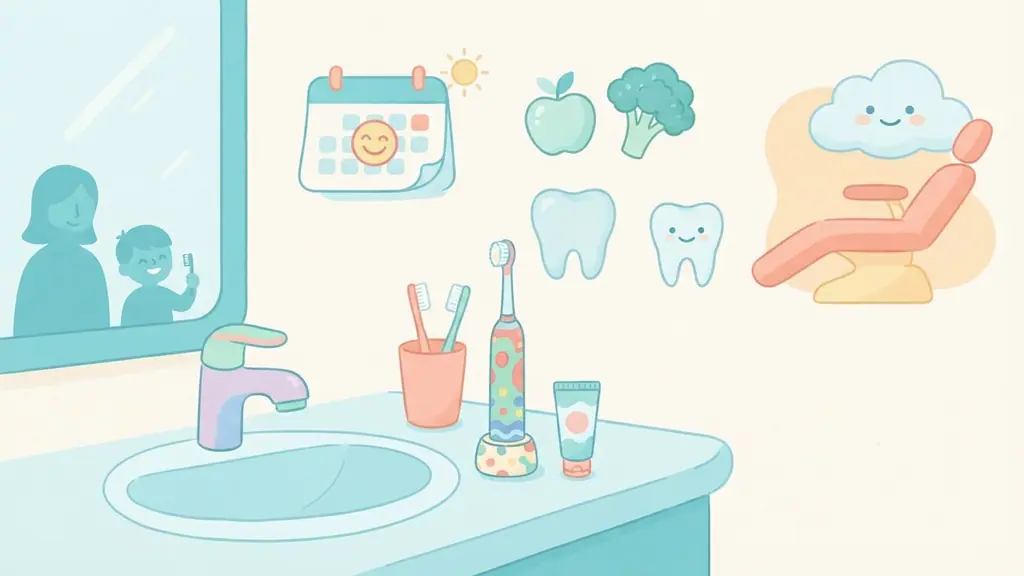
An electric (powered) toothbrush can be a good choice for a child, but it is not essential. What protects young teeth is brushing twice a day, reaching every surface, with the right amount of fluoride toothpaste and an adult helping. A well-used manual brush does that perfectly well.
That said, some children brush more willingly with a powered brush, and some parents find it easier to clean a small, wriggly mouth thoroughly with one. Here is what the evidence says, the practical pros and cons, and how to decide whether and when to switch.
What the evidence says
The most cited summary is a Cochrane systematic review comparing powered and manual toothbrushes. Drawing on 56 trials, it found that powered brushes reduced plaque by about 11% after one to three months and about 21% after more than three months, with gum inflammation (gingivitis) reduced by about 6% and 11% over the same periods. The evidence was rated moderate quality, and the authors noted that the clinical importance of these differences, and the long-term benefit for dental health, remain unclear.
Two points are worth keeping in mind:
- Most of the trials were in adults. There is less direct evidence for young children, so results can't simply be transferred to a toddler's mouth.
- The differences are modest. Good technique with either type matters far more than the kind of brush.
The American Dental Association (ADA) states that both manual and powered brushes can clean teeth effectively, and the European Academy of Paediatric Dentistry (EAPD) recommends brushing children's teeth with either a soft manual or a powered toothbrush.
Pros and cons at a glance
| Possible advantages | Possible drawbacks |
|---|---|
| The brush head does much of the movement, which can help when technique is still developing | Cost of the handle and replacement heads |
| Many children find it novel and motivating | Noise and vibration can be unpleasant, especially for children with sensory sensitivities |
| Built-in timers help reach about two minutes | Needs charging or batteries; can break if dropped |
| Can help children (and adults) with limited dexterity or motor difficulties | Children may rely on the gadget and rush; adults still need to check |
| Small, round heads can be easy to guide around back teeth | Heads must be child-sized and soft; adult heads are too big |
The bottom line: choose the brush your child will actually use, twice a day, with your help. If that's an electric brush, great. If it's a manual one, that's equally fine.
When can a child start using an electric toothbrush?
There is no single official starting age across guidelines. In practice, the right moment depends on your child more than on the calendar:
- The brush is designed for their age. Many powered brushes made for children specify a minimum age on the packaging; follow the manufacturer's guidance.
- The head is small and the bristles soft. A child's head should reach the back teeth easily.
- Your child tolerates the sensation. Some toddlers love the buzzing; others find it overwhelming.
- An adult is still in charge. Whatever the brush, adults should brush for or closely supervise children until about 7 to 8 years.
For babies with their first few teeth, a soft manual infant brush is usually simplest. You can introduce a powered brush later if it seems helpful.
How to brush with an electric toothbrush
The technique differs slightly from manual brushing: you guide the brush rather than scrub.
- Add the right amount of toothpaste: a smear (grain of rice) under 3 years, a pea-sized amount from 3 to 6. See how much fluoride toothpaste to use at each age.
- Place the brush on the teeth before switching it on, to avoid splattering and surprise.
- Move slowly from tooth to tooth, holding the head against each one for a moment, angled slightly toward the gumline. There's no need to press hard.
- Cover every surface: outside, inside and chewing surfaces, top and bottom.
- Aim for about two minutes. Many brushes pulse every 30 seconds to signal moving to another quarter of the mouth.
- Switch off before taking the brush out, then encourage your child to spit, not rinse.
For positions that work for toddlers and preschoolers, see how to brush a child's teeth, step by step.
Introducing a powered brush to a hesitant child
- Let them explore it switched off first, then switched on in their hand, before it goes near their mouth.
- Try it on your own teeth while they watch.
- Start with a few seconds, then finish with a manual brush if needed.
- Use the lowest setting, if there is one.
- Don't force it. If the sensation is distressing, a manual brush is a perfectly good option. Our guide to toothbrushing with sensory sensitivities has more ideas.
Care, hygiene and safety
- Replace the head every three to four months, or sooner if the bristles are splayed, as the ADA advises for all toothbrushes.
- Rinse the head and let it air-dry upright. Remove it from the handle occasionally to clean any residue underneath.
- One head per person. Don't share heads between siblings.
- Keep chargers away from water and out of children's reach.
- Supervise use. As with any toothbrush, children shouldn't walk or run around with it in their mouth.
When to talk to a professional
Ask your child's dentist or pediatric dentist for advice if:
- Your child has difficulty brushing because of a disability, motor difficulty or orthodontic appliance; a powered brush or adapted handle may help.
- Brushing causes bleeding gums that don't settle within a week or two of gentle, regular brushing.
- You see signs of decay (white chalky patches, brown spots) despite regular brushing.
- You're unsure which brush or head size suits your child.
In brief
- Electric and manual brushes can both clean children's teeth well.
- Powered brushes showed modest extra plaque reduction in a Cochrane review, mostly in adults.
- Choose a soft, child-sized head and follow the age guidance on the product.
- Technique, twice-daily brushing, fluoride toothpaste and adult help matter more than the type of brush.
If you're still deciding, our overview on choosing a toothbrush for your child covers the basics for every age.
Sources and further reading
- Powered versus manual toothbrushing for oral health (Cochrane Review summary), Cochrane
- Toothbrushes, American Dental Association (MouthHealthy)
- Guidelines on the use of fluoride for caries prevention in children: an updated EAPD policy document, European Archives of Paediatric Dentistry
- Taking care of children's teeth, NHS