Pacifiers and Teeth: What Parents Need to Know
How pacifiers (dummies) affect babies' teeth and bite, when to start and stop, safe-use tips, and gentle ways to wean a toddler off the pacifier without tears.
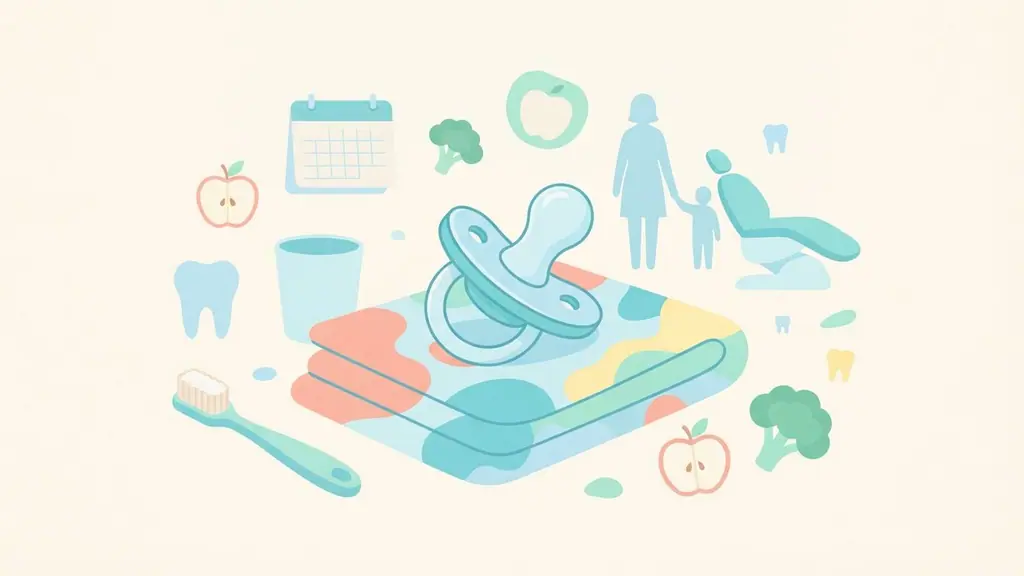
Pacifiers (also called dummies) are a normal part of many babies' lives, and in the early months they can be genuinely useful: sucking is soothing, and the American Academy of Pediatrics (AAP) notes that offering a pacifier at sleep times is linked to a lower risk of sudden infant death syndrome (SIDS).
The dental questions come later. Long, frequent pacifier use beyond the toddler years can change the way the front teeth meet and the shape of the palate. The reassuring news is that these changes often improve on their own if the habit stops early enough. This guide covers when pacifiers are helpful, when to start winding down, and how to use them safely.
Quick answers
| Question | Short answer |
|---|---|
| Is a pacifier bad for a baby's teeth? | Not in infancy. Concerns relate to frequent, prolonged use as a toddler and preschooler. |
| When can I offer one to a breastfed baby? | The AAP suggests waiting until breastfeeding is going well, usually about 3–4 weeks. |
| When should we start cutting back? | The AAPD notes risks to bite development with use beyond about 18 months and encourages stopping by age 3. |
| Will my child's teeth go back to normal? | Often, if the habit stops before the permanent front teeth come in, according to the AAP. |
| Is dipping it in honey or sugar OK? | No. It promotes decay, and honey should never be given to babies under 12 months. |
How pacifiers can affect the teeth and bite
When a child sucks on a pacifier, the object sits between the front teeth and presses against the palate, while cheek and tongue muscles work in a particular pattern. Over months and years of frequent use, this can influence how the teeth and jaws develop.
The American Academy of Pediatric Dentistry (AAPD) policy on pacifiers lists the bite changes associated with prolonged use, including:
- Anterior open bite: the upper and lower front teeth don't meet when the back teeth are together.
- Posterior crossbite: the upper back teeth sit inside the lower ones.
- Changes in the relationship between upper and lower jaws.
The AAPD also notes that pacifier use after 12 months may be associated with a higher risk of middle-ear infections. The American Dental Association (ADA) points out that pacifiers can affect the teeth in much the same way as thumb sucking, but they're usually easier to give up. If your child sucks a thumb or fingers instead, see thumb sucking: when should you worry?
Duration and intensity matter most. A pacifier used only to fall asleep is less likely to cause problems than one used most of the day for years. Effects are generally more noticeable the longer the habit continues.
A timeline that fits most families
- Newborn period: for breastfed babies, wait until feeding is well established (about 3–4 weeks, per the AAP) before offering a pacifier.
- 0–6 months: offering a pacifier at naps and bedtime is reasonable. Don't force it if your baby isn't interested, and don't use it to delay feeds.
- 6–12 months: many families begin limiting use to sleep and moments of real distress, which makes later weaning easier.
- 12–18 months: the AAPD flags potential risks with continued use; consider reducing gradually.
- By 3 years: the AAPD encourages stopping non-nutritive sucking habits by 36 months. The AAP notes that strong sucking beyond about 2–4 years may affect the mouth's shape and tooth alignment.
The AAPD also recommends establishing a dental home by 12 months of age. That first visit is a good moment to ask about pacifier use. Our first dental visit checklist can help you prepare.
Using pacifiers safely
Following AAP advice:
- Choose a one-piece pacifier with a soft nipple and a shield with air holes, too large to fit in the mouth.
- Never tie a pacifier around your baby's neck, hand or to the crib. Clips with long cords are a strangulation risk.
- Don't use a bottle nipple as a pacifier; it can come apart and cause choking.
- Inspect it regularly and replace it if it's cracked, torn or discolored.
- Keep it clean, especially in the first months. Rinse with clean water.
- Never coat it in honey, sugar, syrup or juice. Sugary coatings feed the bacteria that cause tooth decay, and honey carries a risk of infant botulism in babies under 1.
Some parents "clean" a dropped pacifier by putting it in their own mouth. It's better to rinse it with clean water or use a spare. If you're wondering why, read can tooth decay be passed on?
Pacifiers marketed as "orthodontic" or specially shaped are widely available, but evidence that any particular shape prevents bite changes is limited. Limiting how long and how often the pacifier is used matters more than the shape.
How to help your child give up the pacifier
There's no single right method. Choose one that suits your child's age and temperament, and pick a calm period (not during a move, a new sibling's arrival or illness).
- Reduce gradually. Start by keeping the pacifier for sleep only, then only for bedtime, then not at all.
- Use words your child understands. For a toddler: "Pacifiers are for sleeping. Now it's playtime."
- Offer other comfort. A soft toy, a blanket, extra cuddles or a calming bedtime routine.
- Involve your child. Older toddlers and preschoolers might choose to give their pacifiers to a "pacifier fairy" or swap them for a small gift.
- Praise and encourage. A sticker chart works for many preschoolers.
- Stay consistent. Once you've decided, try not to give it back during a tough night; that tends to prolong the process.
- Expect a few hard nights. It's normal for sleep to be unsettled for a little while before things settle.
The AAP advises against teasing, harsh words or punishment, which can upset children and aren't effective.
Pacifiers and tooth decay
A clean pacifier doesn't cause tooth decay by itself. Decay comes from frequent exposure to sugars plus plaque left on teeth. What matters:
- No sweet coatings on pacifiers.
- No bottles of milk or juice in bed. See baby bottle tooth decay.
- Brushing twice a day with a smear of fluoride toothpaste from the first tooth. See when to start brushing your child's teeth.
When to see a dentist
Talk to your child's dentist or pediatric dentist if:
- Your child is over 3 and still uses a pacifier often, and you'd like support to stop.
- You notice the front teeth don't meet, the upper teeth stick out, or the bite looks uneven.
- Your child seems to breathe through the mouth most of the time or snores regularly.
- You have any concerns about speech (a speech and language therapist can also help).
Most children stop using pacifiers without any lasting effects. The aim is a gradual, kind transition well before the permanent front teeth arrive.
Summary
- Pacifiers are fine in infancy and may help at sleep times.
- Prolonged, frequent use can affect the bite; the AAPD encourages stopping by 3.
- Use a one-piece pacifier, never tie it on, and never dip it in anything sweet.
- Wean gradually, with comfort and praise rather than pressure.
Sources and further reading
- Policy on Pacifiers, American Academy of Pediatric Dentistry
- Pacifiers and Thumb Sucking, American Academy of Pediatrics (HealthyChildren.org)
- Thumbsucking, American Dental Association (MouthHealthy)
- Taking care of children's teeth, NHS