The Order Baby Teeth Come In
Baby teeth usually arrive in a predictable order, from the lower front teeth to the back molars. See the sequence, typical ages and which variations are normal.
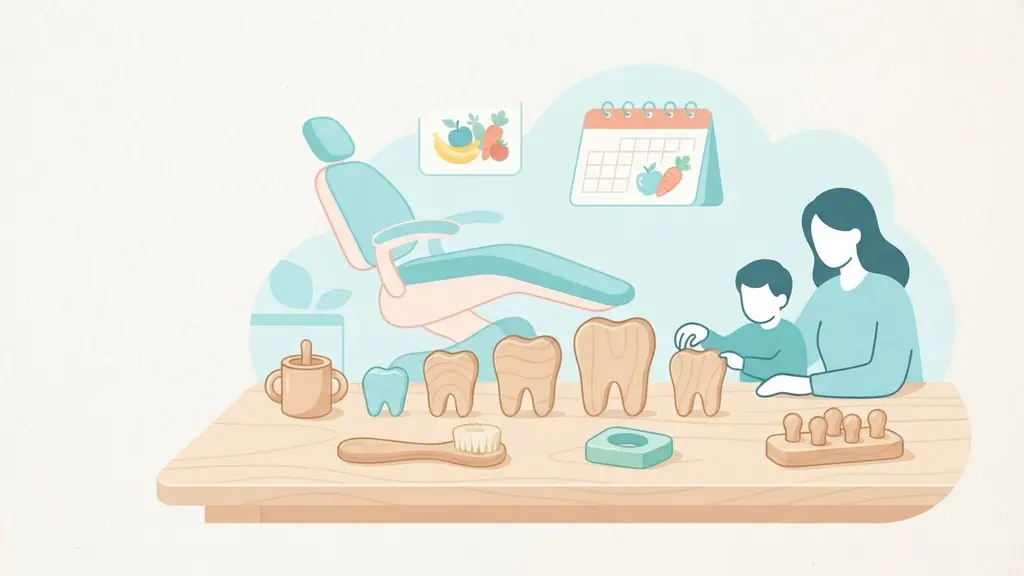
Baby teeth tend to come in following a fairly predictable pattern: first the lower front teeth, then the upper front teeth, then the teeth on either side of them, then the first back molars, the pointed canines, and finally the second molars at the very back. By around age 2 to 3, most children have the full set of 20.
The surprising part for many parents is that the canines usually arrive after the first molars, leaving a gap that fills in later. That's normal.
Below you'll find the usual order, the typical age range for each tooth, and the variations that are nothing to worry about.
The 20 baby teeth at a glance
A full set of baby teeth has 10 on top and 10 on the bottom. On each side of each jaw there are:
- 2 incisors (a central and a lateral), the flat front teeth for biting
- 1 canine, the pointed "eye tooth" for tearing
- 2 molars, the broad back teeth for chewing
Unlike adults, children have no premolars and no third molars (wisdom teeth). Those come with the permanent teeth.
The usual order, step by step
The ages below come from the American Dental Association (ADA) eruption chart.
| Order | Tooth | Lower jaw | Upper jaw |
|---|---|---|---|
| 1 | Central incisors | 6–10 months | 8–12 months |
| 2 | Lateral incisors | 10–16 months | 9–13 months |
| 3 | First molars | 14–18 months | 13–19 months |
| 4 | Canines | 17–23 months | 16–22 months |
| 5 | Second molars | 23–31 months | 25–33 months |
Notice two things. First, lower teeth usually arrive before upper ones, with the exception that upper lateral incisors often come in before lower ones. Second, the age ranges overlap, so your child may cut two different kinds of teeth around the same time.
The NHS uses a simplified version: front teeth at about 6 months, the teeth beside them at about 8 months, first molars at about 12 months, canines at about 18 months and second molars at about 24 months.
You can explore the sequence tooth by tooth, and enter your child's age to see what's likely next, with our baby teeth eruption timeline.
Variations that are usually normal
Every child has their own timetable. Variations of a few months, or a pair of teeth arriving slightly out of order, are very common and rarely a cause for concern.
- A different order. An upper tooth might come in before a lower one, or a lateral incisor before a central one.
- Teeth in clusters. Some babies get several teeth within a few weeks, then nothing for months.
- Gaps. Spaces between baby teeth are normal and actually helpful: adult teeth are bigger and will need the room.
- A gap where the canine will go. Because canines usually follow the first molars, there's often a space beside the incisors for a while.
- Teeth that look a little crooked as they come in. Lips, cheeks and tongue tend to guide them into a better position over time.
What each stage can mean for comfort
Not all teeth feel the same coming through. Many parents find the molars, which are broader, cause more discomfort than the front teeth, but babies vary widely. Our guide to understanding teething explains which signs are typical and how to soothe sore gums safely.
Looking after each new tooth
Every tooth needs cleaning from the moment it appears.
- First teeth (front incisors). Brush twice a day with a soft baby toothbrush and a smear of fluoride toothpaste. See when to start brushing your child's teeth.
- First molars. These have grooves where food collects. Take extra time on the chewing surfaces, especially at bedtime.
- When teeth touch. Once two teeth touch each other, the ADA recommends starting to floss between them.
- Second molars. By now brushing should be a firm twice-daily routine, with an adult doing the brushing or at least finishing the job.
Toothpaste amounts depend on age and on national guidance. In the US, the AAPD and ADA advise a grain-of-rice smear under 3 and a pea-sized amount from 3 to 6. The NHS and European guidance also set a fluoride strength (at least 1,000 ppm for young children). See fluoride toothpaste by age for details.
Questions parents often ask
Is it a problem if the top teeth come in first? Usually not. Lower teeth tend to lead, but an upper tooth arriving first is a common variation and doesn't predict any later problem.
Why does my toddler have a gap beside the front teeth? That's where the canines will go. Because the first molars usually come in before the canines, a temporary space beside the incisors is expected.
Do all children end up with 20 baby teeth? Most do. Occasionally a child has a missing or an extra tooth, which a dentist can spot during routine check-ups, sometimes with an X-ray when the child is older.
Does an early or late order affect adult teeth? The timing of baby teeth doesn't reliably predict how straight the adult teeth will be. Keeping baby teeth healthy until they fall out naturally matters more, because they hold space for the permanent teeth.
When to see a professional
Mention it to a pediatric dentist or your child's doctor if:
- Your baby has no teeth by their first birthday (the first dental visit, recommended by then anyway, is a good time to ask)
- A tooth on one side has come in but its partner on the other side hasn't, many months later
- Teeth look discolored, pitted, unusually shaped or very widely spaced
- There's a swelling over a coming tooth that seems painful or keeps growing
- Your child has all their other baby teeth but some are still missing well after age 3
The AAPD, ADA and AAP recommend a first dental visit by the first birthday or within six months of the first tooth, so a professional will usually be keeping an eye on the sequence from early on. Our first dental visit checklist can help you prepare.
Quick recap
- Usual order: lower front teeth, upper front teeth, lateral incisors, first molars, canines, second molars.
- Canines usually come after the first molars, so a temporary gap is normal.
- Lower teeth usually lead, but small changes in the order are common.
- Most children have all 20 baby teeth by about age 2 to 3.
- Brush each new tooth twice a day with fluoride toothpaste, and floss once teeth touch.
Sources and further reading
- Eruption Charts, American Dental Association (MouthHealthy)
- Baby teething symptoms, NHS
- Baby Teeth, American Dental Association (MouthHealthy)
- Oral Health Policies and Recommendations (The Reference Manual of Pediatric Dentistry), American Academy of Pediatric Dentistry